There’s a particular smell that doesn’t politely introduce itself.
It just shows up—sharp, green, peppery—and suddenly you’re not “here” anymore. You’re somewhere. A place with concrete underfoot, old towels stacked like sacred supplies, and air that feels cool even when it’s late summer outside.
If you’ve ever brushed past a tomato plant and caught that burst of leaf—vegetal, alive, almost spicy—you know the scent. It’s not “pretty.” It’s not floral. It’s not designed to be loved, but to me it is loved.
And, it’s unforgettable.
Wine does this too.
The scent that time can’t erase
Some aromas don’t read like fruit --they read like place.
Tomato leaf smells like soil and sun and something you can’t fake—like the plant is telling the truth about where it came from. It’s the opposite of polished. It’s raw and specific, the way real things are.
In wine, that same truth shows up in the scents that aren’t trying to charm you:
damp stone, cellar air, mushroom, wet earth, savory herbs, the “barnyard” notes people either love or politely pretend they don’t notice
These aren’t flaws (at least, not automatically). They’re often signatures—clues that a wine is connected to something more grounded than just fruit sweetness.
“Basement notes” and why some people crave them
There’s a reason certain wines feel comforting even when they’re not “smooth” or “easy.” Texture and earthiness can make a wine feel lived-in. Like it has corners. Like it has stories.
You’ll find this kind of character in places and styles that lean savory:
- Old World reds where earth, leather, and herbs sit alongside fruit
- Cool-climate wines that give you that green edge (think herbal, peppery, sometimes tomato-leaf-adjacent)
- Wines with bottle age, where fresh fruit steps back and the cellar takes the mic
- Certain natural or minimally handled wines, where you can sometimes get that funky “stable/barn” thing (beloved by some, terrifying to others)
These aromas aren’t about being “dirty.” They’re about being real. They remind us that wine is agricultural before it’s aesthetic.
The basement is the point. A basement is not a tasting room. It’s not curated. It’s cool and dim and practical—concrete, jars, old equipment humming like it’s been working since the Truman administration.
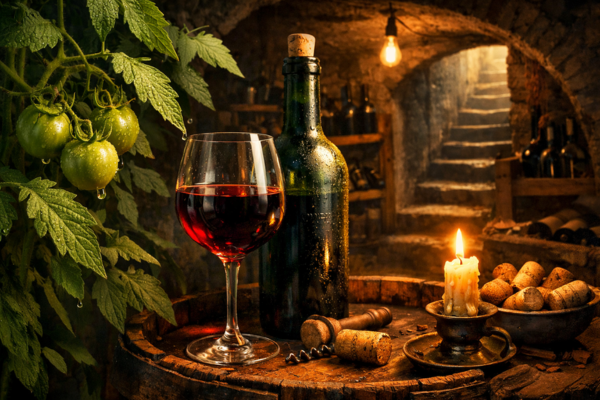
That atmosphere—stone, damp air, time—has a direct cousin in wine: the smell of a cellar. It’s why the words we use for wine are often the same words we use for memory: musty, earthy, layered, lingering.
And it’s why a wine can hit your nose and suddenly you’re somewhere else—no warning, no buildup, just a clean sensory shortcut.
Wine doesn’t just taste like something. It remembers something.
We talk about wine like it’s all structure and notes and pairings. But the deeper pull is emotional: scent bypasses analysis. It goes straight to the part of you that keeps old seasons intact.
Sometimes the most meaningful wines aren’t the prettiest. They’re the ones with a whisper of soil under the fruit. The ones with a little cellar in them. The ones that don’t smell like a candle… and thank god for that.
Because some memories don’t fade.
They ferment.